










CAPITALDIGEST DAILYNEWS, 12/10/2026
October 12, 2026
FUEL DISCOUNT WON’T COST GOVERNMENT PUBLIC FUNDS, FG INSISTS
The Federal Government has said the petrol discount introduced by the Nigerian National Petroleum Company Limited’s retail arm is not a return of fuel subsidy, insisting that no public funds are being used to reduce prices at its filling stations. The government said the discount was funded by NNPC Retail Limited’s decision to reduce its retail profit margin, rather than through payments from the federal budget or the Federation Account. The Minister of Finance and Coordinating Minister of the Economy, Taiwo Oyedele, stated this in a release issued by the Federal Ministry of Finance in Abuja on Friday, titled, “The NNPC Retail Discount Is Not a Subsidy: No Public Money Is Involved.” The clarification followed an earlier announcement by the Presidency that NNPC Retail would forgo its retail profit margin on petrol and sell at cost as part of measures to cushion households against global oil-price shocks. In a statement issued on Thursday and signed by the Special Adviser to the President on Information and Strategy, Bayo Onanuga, the Presidency said the arrangement, backed by President Bola Tinubu, was not a return of the petrol subsidy removed in 2023. However, explaining the difference between a retail discount and a subsidy, Oyedele said, “Some commentators have described the discount as a return of fuel subsidy. That is not correct. Here, plainly, is what the discount is and what it is not.” He added, “A margin discount means the retailer chooses to take a smaller margin, or no margin at all for a period, and passes the saving to the customer. The cost of the discount is borne by the retailer alone.” According to the minister, a subsidy involves the government paying part of the price consumers would otherwise pay, using public revenue. “A subsidy is different. It is when government pays part of the price the consumer would otherwise pay. That money comes from public revenue — funds that would otherwise go to salaries, schools, hospitals and infrastructure. That is the regime this administration ended in 2023, and it is not coming back,” he said. Oyedele stated, “The discount is not funded by the federal budget or the Federation Account.” He explained that NNPC Retail purchases petrol from the Dangote Refinery and other suppliers at market prices and on commercial terms before adding its retail margin. Under the discount arrangement, the company reduces that margin to lower the price paid by customers. The minister also said selling crude oil below market prices could amount to a subsidy if the resulting shortfall were borne by public revenue. NNPC Retail, a wholly owned subsidiary of NNPC Limited, was established more than 20 years ago as a petroleum marketing and retail company. Oyedele said its role included ensuring the availability and affordability of refined products nationwide. “Its purpose, in other words, is to keep products available across the country and to moderate retail prices, not necessarily to maximise retail profit,” he said. The minister argued that reducing the margin on each litre of petrol would not necessarily reduce NNPC Retail’s overall profits or the dividends paid to the Federation, as higher sales volumes and customer loyalty could offset the lower margin. “A smaller margin or temporary zero margin on each litre can be more than offset by selling more litres over time. And a discount builds customer loyalty that lasts well beyond the discount period itself,” he said. He added, “Together, these can raise NNPC Retail’s profits, and the dividends paid to the Federation: a win-win for consumers and for government.” Addressing concerns that the discount could encourage petrol smuggling into neighbouring countries, Oyedele said the retail margin represented less than five per cent of the pump price. “The retail margin on petrol is less than 5 percent of the pump price. A discount within that margin cannot meaningfully widen the gap between prices in Nigeria and in neighbouring countries, where petrol already costs 20 to 40 percent more,” he said. He added, “It therefore creates no new incentive for smuggling, and no distortion of the kind that subsidy regimes produced in the past.” The minister listed other government measures aimed at easing the impact of fuel costs, including expanding compressed natural gas deployment for transport, waiving taxes and duties on petrol, and removing illegal levies that increase transportation costs. “Each is designed to bring relief without returning Nigeria to a subsidy regime that the country can no longer afford,” he said. Summing up the government’s position, Oyedele said, “A subsidy spends public money to lower the price of fuel. The NNPC Retail discount lowers the price without spending any public money, and it can strengthen NNPC Retail’s business at the same time.”

FX TURNOVER FALLS TO $1.7BN AS SPOT TRADING DROPS
Trading activity in Nigeria’s foreign exchange market fell sharply last week, as total turnover across the spot and derivatives segments dropped to $1.70 billion. Data from FMDQ showed that turnover for the week ended 2 October 2026 fell by 35.4 per cent from $2.63bn recorded in the previous week. The decline was largely caused by a sharp fall in spot transactions, which account for most trading in the market. FX spot turnover dropped by $955.7m, or 36.9 per cent, to $1.63bn from $2.59bn a week earlier. Average daily spot trading also fell to $408.06m from $517.59m. As a result, spot transactions accounted for 96.2 per cent of total FX turnover during the week, down from 98.5 per cent previously. Spot turnover means the total value of FX bought and sold for immediate or near-immediate delivery in the FX market. The decline suggests that activity in the main segment of the official FX market weakened considerably during the week, despite continued demand for foreign currency. Total average daily FX turnover fell to $424.24m from $525.43m. Unlike the spot market, trading in FX derivatives increased during the week. Derivatives turnover, mainly made up of FX forwards, rose by 65.1 per cent to $64.73m from $39.21m. However, the increase was not enough to offset the much larger decline in spot transactions. Derivatives accounted for just 3.8 per cent of total FX turnover, meaning that most activity in Nigeria’s FX market still takes place through spot transactions. The decline in trading activity came despite continued demand for foreign exchange. Nigeria’s gross external reserves increased by $62.17m million to $54.93bn as of 30 September. The reserves had also risen by $1.11bn in September, suggesting that the country continued to record some improvement in its external liquidity position. However, the rise in reserves has not completely removed pressure from the FX market.
NDIC PAYS N69.65BN TO DEPOSITORS OF FAILED BANKS
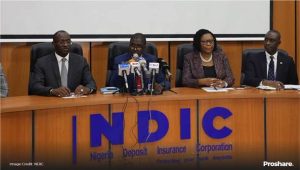
The Nigeria Deposit Insurance Corporation has disclosed that it has paid a cumulative N69.65bn to insured depositors of failed financial institutions as part of efforts to protect bank customers and strengthen confidence in the banking system. The Director of Strategy Development at the NDIC, Mrs Gwa Uduak, disclosed this on Thursday during the opening ceremony of the corporation’s 2026 Customer Service Week commemoration in Abuja. Uduak said, “Cumulative payments to insured depositors have reached N69.65bn,” adding that the corporation had also made payments to uninsured depositors through its bank liquidation activities. She explained that the payments reflected the corporation’s commitment to protecting depositors and reducing the financial hardship associated with bank failures. “Behind every payment is a depositor, a family, or a business seeking assurance at a time of financial uncertainty,” she said. Uduak noted that the NDIC’s responsibilities included deposit guarantees, banking supervision, the resolution of distressed financial institutions and the liquidation of failed banks. She explained that the corporation conducted periodic examinations of banks and collaborated with the Central Bank of Nigeria to implement coordinated resolution frameworks aimed at preventing failures and maintaining financial stability. Further details of the corporation’s payments were contained in a video presentation played during the event. According to the presentation, the NDIC paid N1.48bn to 10,312 insured depositors of 47 failed microfinance banks as of July 31, 2026. The affected institutions included Abia SME Microfinance Bank, Frontline Microfinance Bank and Goldman Microfinance Bank, among others. The corporation also disclosed that it paid N1.15bn to 1,082 depositors of Union Homes Savings and Loans Plc and N313.02m to 8,248 depositors of Aso Savings and Loans Plc under its accelerated payment programme in 2026. The presentation showed that the NDIC leveraged Bank Verification Number validation through the Nigeria Inter-Bank Settlement System to identify depositors and obtain alternative bank account details for faster settlement. It added that insured deposit payments now commence within three days of the revocation of banking licences for newly closed banks. Speaking at the event, the NDIC Managing Director and Chief Executive Officer, Thompson Sunday, said the corporation remained committed to strengthening depositor protection and improving service delivery. “For close to four decades now, from 1988 to this period, the NDIC has played a role in safeguarding the confidence that underpins the Nigerian financial system,” he said. Sunday disclosed that the corporation had embarked on an institutional transformation initiative known as NDIC Ascend to improve operational processes, strengthen collaboration and integrate technology into service delivery. He stressed that the corporation’s effectiveness depended on its ability to respond promptly to the needs of depositors and other stakeholders. Also speaking, the Acting National Coordinator and Chief Executive Officer of SERVICOM, Mrs Helen Lawal, urged the corporation to prioritise timely complaint resolution and improved customer engagement. “It is important for us not to wait for customers to complain, but for us to anticipate their needs and go about solving them,” she said. Lawal commended the NDIC for introducing the Service Level Agreement Management System to monitor departmental performance against agreed service delivery standards. Earlier, the Head of the NDIC SERVICOM Unit, Mrs Chinyere Ogunsakin, said the celebration provided an opportunity to recognise employees and strengthen stakeholder engagement. She explained that the theme, The Extra Mile, emphasised the importance of consistently exceeding customer expectations. The video presentation also showed that the NDIC provides supervisory oversight for 37 deposit money banks, 32 primary mortgage banks, 813 microfinance banks, five payment service banks and 30 mobile money operators.
CBN MOPS UP N3.3TN DESPITE FRESH LIQUIDITY INFLOW
The Central Bank of Nigeria withdrew N3.31 trillion from the banking system through its latest Open Market Operations auction, even as N2.17tn from maturing bills returned to banks. The result was a net liquidity withdrawal of about N1.14tn, as the CBN continued its efforts to reduce excess cash in the financial system. Investors submitted N3.51tn in bids for the auction, against the N2tn initially offered by the apex bank. The CBN eventually allotted N3.31tn, with demand strongest for the longer-term 182-day bill. The 182-day bill attracted N2.69tn in bids against N1tn offered. The CBN allotted N2.67tn at a stop rate of 16.92 per cent. By comparison, the 147-day bill received N817.95bn in bids against N1tn on offer. The CBN allotted N637.2bn at a stop rate of 17.22 per cent. The stronger demand for the 182-day bill suggests investors were more willing to lock their money away for longer, even though the return was slightly lower than that of the shorter bill. Both stop rates fell slightly from the previous auction on 29 September. The latest auction comes after the CBN carried out large-scale liquidity withdrawals in September. The apex bank sold N17.51tn worth of OMO bills during the month, while N10.89tn matured. This left a net withdrawal of about N6.62tn from the banking system. The 29 September auction alone saw the CBN sell N4.69tn of OMO bills against N2.43tn in maturities. The October auction was smaller than that September operation, but it still resulted in a sizeable net withdrawal. The move shows that the CBN is continuing to use OMO bills to control excess liquidity even after cutting its benchmark interest rate. The liquidity squeeze also affected short-term borrowing costs. The overnight lending rate rose by 25 basis points to 22.2 per cent. However, there is still significant liquidity in the banking system. More than N6.2tn was placed with the CBN through the Standing Deposit Facility on 29 September, while estimated net system liquidity stood at N8.57tn that week. The latest OMO operation therefore reflects that the CBN is lowering its main policy rate while, at the same time, removing excess funds from the financial system. The Monetary Policy Committee cut the Monetary Policy Rate by 350 basis points to 23 per cent on 22 September. The combination of lower policy rates and continued OMO sales suggests the CBN wants to make borrowing conditions easier over time without allowing excess liquidity to build up and create fresh pressure on inflation and the foreign exchange market.

NGX DROPS BELOW 250,300 POINTS AMID BEARISH SENTIMENT
The equities market on the Nigerian Exchange extended its losing streak to a fifth consecutive session as sustained risk-off sentiment dragged trading performance lower. The All-Share Index declined by 394.36 points, representing a loss of 0.16 per cent, to close at 250,273.50 points on Tuesday. Similarly, the overall market capitalisation value shed N256bn to close at N162.496tn. The negative performance was driven by price depreciation in large and medium capitalised stocks, including First Holdco, Unilever Nigeria, Fidson Healthcare, Ecobank Transnational Incorporated, and Stanbic IBTC Holdings. The decline reflects continued cautious sentiment and profit-taking as investors remained reluctant to sustain the market’s recent gains. Market analysts stated that the session was characterised by bearish sentiment and weaker trading activity, as continued selling pressure pushed equity valuations further into negative territory. Investor sentiment closed negative as 34 losers outpaced 26 gainers. Tripple Gee & Company recorded the highest price gain of 9.77 per cent to close at N2.81 per share, followed by Livestock Feeds with a 9.74 per cent gain to close at N10.70. NPF Microfinance Bank rose by 9.52 per cent to close at N4.60, Sovereign Trust Insurance appreciated by 8.23 per cent to close at N2.50, and Wapic Insurance advanced by 7.69 per cent to close at N2.38 per share. Conversely, Critical Minerals Financing Corporation led the losers’ table, dropping 9.88 per cent to close at N3.65 per share. ABC Transport followed with a 9.70 per cent decline to close at N6.05, while CWG dipped by 7.23 per cent to close at N19.25. Zichis Agro Allied Industries fell by 6.58 per cent to close at N17.05, and Neimeth International Pharmaceuticals declined by 6.17 per cent to close at N7.60 per share. Total volume traded fell by 33.8 per cent to 579.25 million units, valued at N36.07bn, and exchanged across 41,072 deals. Transactions in the shares of Access Holdings topped the activity chart with 192.576 million shares valued at N5.781bn. United Bank for Africa followed with 32.747 million shares worth N1.473bn, while Zenith Bank traded 30.821 million shares valued at N4.185bn. Fidelity Bank traded 29.916 million shares valued at N691.686m, while Guaranty Trust Holding Company transacted 19.564 million shares worth N2.596bn.