












CAPITALDIGEST DAILYNEWS 05/10/2026
October 5, 2026
OIL PRICES SLIP BELOW $100 AS IRAN TALKS ADVANCE
Oil prices slipped below the $100 per barrel mark on Wednesday as diplomatic efforts between the United States and Iran raised hopes of an easing in tensions around the Strait of Hormuz, a key route for global oil shipments. Brent crude was trading at about $98.18 per barrel, while US West Texas Intermediate stood at around $90.64, according to market data supplied on Wednesday. The decline came as Iran said it had received a response from the United States to its latest proposal aimed at reviving a collapsed ceasefire and easing the conflict between the two countries. According to Reuters, Iranian Foreign Minister Abbas Araqchi received the US response through Qatari mediators after talks between the two sides last week on the sidelines of the United Nations General Assembly in New York. Iran’s proposal includes a seven-day plan under which the United States would lift its blockade of Iranian ports while Tehran would reopen the Strait of Hormuz and restore normal maritime passage, according to Reuters. However, the two sides remain divided over the order in which the proposed steps should be implemented, meaning there has been no agreement to reopen the strategic waterway. The Strait of Hormuz is one of the world’s most important oil shipping routes, and the conflict has substantially disrupted the movement of crude oil, refined products and natural gas through the waterway. Shipping through the strait has increased in recent weeks, although vessels have been charging high fees to navigate the route because of the security risks. Reuters reported that two ships were hit by projectiles on Tuesday, according to Britain’s UKMTO maritime security body. Oil prices have remained highly sensitive to developments around the conflict. Brent had climbed above $100 per barrel earlier in September as attacks on shipping and energy infrastructure heightened fears of further supply disruptions. The latest movement below $100 therefore reflects changing expectations around supply disruption rather than evidence of a sudden collapse in global oil demand. Reuters reported on Wednesday that analysts had raised their 2026 oil-price forecasts because disruptions to Gulf exports, particularly through the Strait of Hormuz, continue to offset concerns about demand growth. The development also comes as Qatar continues to mediate between Washington and Tehran, with Doha saying it hopes its shuttle diplomacy can help the two sides reach an agreement and avoid further repercussions from the conflict.

CBN PREPARES TO MOO UP N4.69TN AS LIQUIDITY RISES
Liquidity in Nigeria’s banking system climbed sharply to N8.84tn ahead of the settlement of the Central Bank of Nigeria’s latest Open Market Operation bills, raising expectations of a substantial cash withdrawal from the financial system. The latest liquidity position represents a 37.01 percent increase from N6.45tn, according to market data from AIICO Capital Limited. The surge has pushed excess liquidity to more than twice the N3.82tn recorded at the beginning of the year, reflecting the combined impact of OMO maturities and other inflows into the money market. The buildup occurred despite renewed efforts by the CBN to absorb surplus cash through the sale of government securities. The apex bank offered N2.5tn in OMO bills across three maturities on Tuesday, with strong investor demand reportedly taking the eventual amount raised to about N5tn. The transactions are expected to reverse part of the liquidity buildup once the securities are settled, with market participants closely monitoring the impact on short-term funding rates. Despite the abundant liquidity, overnight borrowing costs recorded a modest increase. Analysts said the overnight lending rate rose by 28 basis points to 20.86 per cent, while the overnight policy rate remained at 20.50 per cent. The Nigerian Overnight Financing Rate, however, stayed at 20 percent, which represents the lower boundary of the current interest-rate corridor following the CBN’s recent monetary policy easing. The average Treasury bill rate also remained unchanged at 17.84 percent, according to AIICO Capital. AIICO Capital expects money market rates to remain close to the 20 percent floor as long as banking-system liquidity remains above N8tn. The investment firm, however, expects the settlement of the latest OMO transaction to significantly reduce the amount of cash available to banks. According to the market assessment, about N4.69tn from the OMO sale is expected to be debited from the system upon settlement. This would represent a sizeable withdrawal from the current N8.84tn liquidity pool and could alter the direction of short-term money-market rates. The liquidity position has become an important market indicator as banks manage their cash positions amid the CBN’s ongoing use of open-market operations to regulate financial-system liquidity. The heavy demand for OMO instruments also highlights continued appetite for high-yielding naira assets, particularly as monetary policy and short-term interest rates adjust.

NGX DROPS N425BN ON MONTH-END PROFIT-TAKING
The Nigerian equities market closed the final trading session of September on a bearish note, as profit-taking dragged key benchmark metrics lower, eroding N425.73bn in investor wealth. At the close of transactions on Wednesday, the All-Share Index of the Nigerian Exchange Limited dropped by 0.28 per cent to settle at 251,211.67 basis points, compared to 251,913.20 points recorded on Tuesday. In tandem with the contraction in index points, total market capitalisation shrank from N163.53tn to N163.10tn. Market sentiment remained mixed across key sector indices, with heavy selling pressure impacting blue-chip banking and telecommunications firms, while selective demand in industrial and consumer goods stocks provided mild cushioning. The NGX Premium Index slid by 1.02 per cent to close at 31,771.57 points, largely hampered by losses in major telecom and banking giants. The NGX Banking Index lost 0.58 per cent to drop to 2,712.10 points, while the NGX Insurance Index fell by 1.01 per cent to 1,087.10 points. Conversely, the NGX Industrial Index posted a gain of 0.66 per cent to reach 10,440.27 points, buoyed by buying interest in BUA Cement Plc. The NGX Consumer Goods Index recorded a slight uptick of 0.04 per cent to finish at 4,058.25 points, while the NGX Growth Index expanded by 0.68 per cent to 27,452.85 points. Trading volume across the bourse experienced substantial activity, with investors exchanging 1.035 billion shares in 44,398 deals. VFD Group Plc led the volume chart, recording an exchange of 367.32 million shares. UAC of Nigeria Plc followed with 158.18 million shares traded, Abbey Mortgage Bank Plc with 72.43 million shares, Chams Holding Company Plc with 63.89 million shares, and Guaranty Trust Holding Company Plc with 39.55 million shares. On the gainers’ chart, Haldane McCall Plc emerged as the top performer, advancing by the maximum daily limit of 10.00 per cent to close at N3.41 per share from N3.10. Critical Minerals Financing Corp Plc appreciated by 9.92 per cent to close at N4.32, Cornerstone Insurance Plc climbed 9.80 per cent to N5.60, LivingTrust Mortgage Bank Plc surged 9.79 per cent to N3.14, and ABC Transport Plc rose 9.76 per cent to N6.75 per share. Other notable gainers included Royal Exchange Plc (+9.52 per cent to N1.15), VFD Group Plc (+8.21 per cent to N14.50), BUA Cement Plc (+N9.20 to N297.00), and Oando Plc (+1.45 per cent to N35.00). On the losers’ log, Learn Africa Plc topped the decliners, dropping 10.00 per cent to close at N7.65 per share from N8.50. Thomas Wyatt Nigeria Plc fell by 9.80 per cent to N2.67, while Sovereign Trust Insurance Plc lost 6.78 per cent to end at N2.20. Heavyweight telecom stock MTN Nigeria Communications Plc recorded a decline of 3.01 per cent, shedding N26.00 to close at N837.00 per share. Tier-one lenders also faced selling pressure as Access Holdings Plc declined 2.25 per cent to N30.40, United Bank for Africa Plc dropped 1.20 per cent to N45.45, and GTCO eased 0.38 per cent to N132.00 per share.

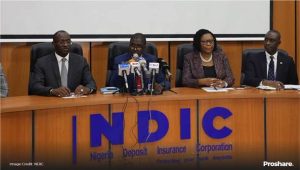
NDIC BLOWS WHISTLE ON ILLEGAL MONEY SCHEMES
The Nigeria Deposit Insurance Corporation has raised the alarm on the rapid spread of illegal money schemes across the country, cautioning citizens against putting their hard-earned money in unregulated institutions or illegal fund operators. The Managing Director and Chief Executive Officer of the Corporation, Thompson Sunday, delivered the warning on Wednesday in Abuja during the NDIC Special Day at the 21st Abuja International Trade Fair. Speaking on the overarching theme of the fair, “Resilience: Trade, Taxation and the Economy,” the NDIC boss emphasised that safeguarding individual savings and ensuring a stable banking climate are fundamental to achieving the Federal Government’s target of a $1tn economy by 2030. Addressing participants and key business stakeholders at the event, Sunday made a direct appeal to the public to avoid high-yield financial traps that lack regulatory backing. He expressed grave concern over how unsuspecting citizens continue to fall victim to speculative investment setups that promise unsustainable returns. “There are still Nigerians who keep substantial funds outside the formal banking system or entrust their savings to unlicensed fund managers, attracted by promises of extraordinary and unrealistic returns,” he stated. The NDIC chief noted that the consequences of these choices are often disastrous, pointing out that “the proliferation and collapse of Ponzi schemes have demonstrated, time and again, the enormous financial and emotional cost of placing hard-earned resources in unregulated schemes.” He advised citizens to exercise strict caution, adding that “if an investment promise sounds too good to be true, Nigerians should pause, ask questions and verify before committing their money.” In contrast to the grave risks of illicit schemes, Sunday highlighted the safety measures provided by licensed banking institutions, noting that the NDIC acts as a critical safety-net pillar to safeguard customer deposits. He pointed out that following a significant policy enhancement in 2024, maximum deposit insurance coverage limits were raised to N5m per depositor for Deposit Money Banks and Mobile Money Operators, alongside N2m per depositor for Microfinance Banks, Primary Mortgage Banks, and Payment Service Banks. According to the NDIC MD, this enhancement guarantees 100 per cent deposit coverage for more than 98 per cent of bank depositors nationwide, shielding households and small enterprises from the fallout of bank insolvencies. He added that for account balances above the insured limits, the NDIC steadily distributes liquidation dividends derived from debt recoveries and asset disposals so that no depositor loses faith in the financial system. To streamline depositor protection, the NDIC boss revealed that the Corporation has fully embraced modern digital systems to deliver faster claim payments, shifting away from slow, paper-heavy physical verifications. By leveraging tools like the Single Customer View framework, Bank Verification Numbers, and NIBSS payment infrastructure, verified depositors now receive payments within days of a bank closure.Furthermore, Sunday announced the launch of an upgraded interactive website, featuring a digital portal complete with a one-click Quick Action Bar for filing claims and checking bank statuses, as well as an AI-powered virtual assistant designed to offer real-time guidance to the public. He encouraged depositors to ensure their account records and BVNs remain properly synchronized across institutions to enable seamless background verifications.
NIGERIAN FX MARKET SURGES 11% TO $2.63BN
The foreign exchange market in Nigeria experienced a notable surge in activity for the week ended 25 September 2026, driven by strong growth across both spot and derivatives transactions. According to market data released by FMDQ Group Plc, total turnover across FX Spot and Derivatives markets reached $2.63bn. This represents an 11.02 per cent increase, or an additional $260.85m, compared to the $2.37bn recorded in the previous week ended 18 September 2026. The weekly gain marks a quick rebound for the official market window following a sharp 30 per cent contraction during the prior week, where total weekly turnover had dropped from nearly $3.4bn to $2.37bn due to temporary dips in derivative execution. Over the past two years, FX activity on the FMDQ Exchange platform has expanded significantly following structural market reforms initiated by the Central Bank of Nigeria. These reforms, including the adoption of a market-driven “willing buyer, willing seller” system, order-based quotation platforms, and the clearance of legacy backlogs, have helped stabilise liquidity, boost diaspora remittance flows, and allow commercial banks and their corporate clients to execute larger transaction volumes without relying heavily on direct central bank intervention. The overall expansion in weekly volume was largely underpinned by robust performance in the FX Spot market, which continues to account for the vast majority of official trading in the country. Spot transactions rose 10.62 per cent week-on-week, growing by $248.42m to settle at $2.59bn compared to $2.34bn in the week ended 18 September. This increase lifted the daily average spot turnover from $467.90m to $517.59m, representing 98.51 per cent of overall market activity. Concurrently, the FX Derivatives segment, comprising FX Forwards, saw a substantial proportional increase following a slowdown earlier in the month. Turnover in derivatives jumped 46.42 per cent, climbing from $26.78m to $39.21m for the week. The $12.43m weekly gain boosted the daily average derivative volume from $5.36m to $7.84m, expanding its overall market share slightly from 1.13 per cent to 1.49 per cent. Overall, average daily trading volume across the entire FX market climbed from $473.26m to $525.43m. The combined figures highlight a week of heightened liquidity and renewed engagement between authorised dealer banks and their clients across both immediate and forward settlement windows, supporting ongoing efforts to deepen price discovery and improve capital flows within the domestic economy.